
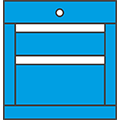
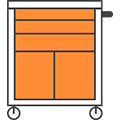











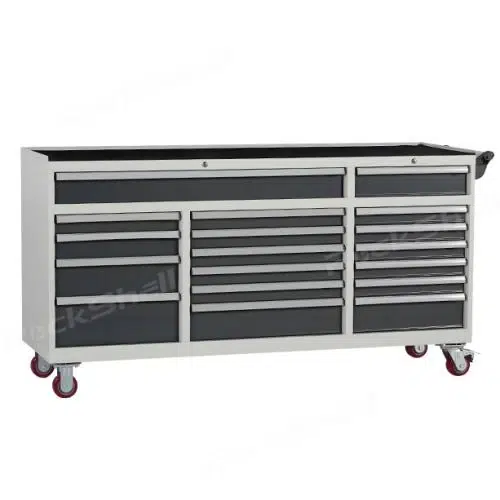


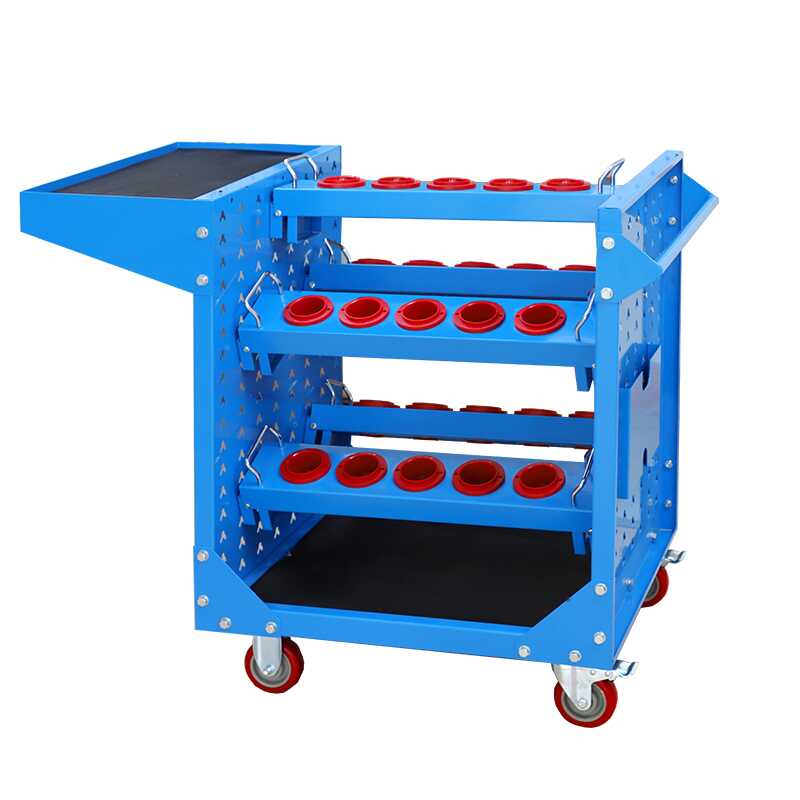


In industrial workshops, manufacturing plants, and professional maintenance environments, the industrial metal tool cabinet is the most widely used and reliable tool storage solution. In contrast, wooden tool cabinets are more commonly applied in light-duty or home-use scenarios. The two options differ significantly in terms of material performance, load capacity, service life, and safety.
This article provides a systematic comparison between industrial metal tool cabinets and wooden tool cabinets across multiple key dimensions, helping businesses make informed purchasing decisions.
1. Material and Structural Strength
An industrial metal tool cabinet is typically manufactured from cold-rolled steel or high-strength steel, offering a rigid and stable structure. It is designed to withstand frequent use and heavy loads without deformation.
Wooden tool cabinets are generally made from solid wood, plywood, or laminated panels. Under light-load conditions, they remain structurally stable and provide natural cushioning, making them more suitable for precision or delicate tools.
Comparison Summary:
Metal tool cabinets are better suited for high-intensity industrial environments, while wooden tool cabinets perform well in low-load applications where vibration protection is required.
2. Load Capacity and Application Scenarios
Industrial metal tool cabinets offer high single-drawer and overall load capacities, often reaching several hundred kilograms. They are ideal for storing heavy hand tools, power tools, and precision equipment, and are widely used in automotive manufacturing, machining, and equipment maintenance.
Wooden tool cabinets have lower load capacities and are more suitable for light-duty tools or daily-use items. They are also easier to fabricate and adapt for small-scale applications.
Comparison Summary:
For high-load and high-frequency use, the industrial metal tool cabinet is the safer and more reliable choice.

3. Durability and Service Life
Metal materials provide excellent wear resistance and impact resistance. With a powder-coated finish, an industrial metal tool cabinet offers effective protection against rust and corrosion, achieving a service life of over ten years.
Wooden tool cabinets can also deliver long-term performance in dry, temperature-controlled environments. However, they require more frequent maintenance in humid or variable-temperature conditions.
Comparison Summary:
Industrial metal tool cabinets offer superior durability and lower long-term ownership costs.
4. Safety and Tool Protection
An industrial metal tool cabinet is commonly equipped with central locking systems and drawer interlock mechanisms, preventing accidental drawer extension and improving workplace safety. These features also protect valuable tools from unauthorized access.
While wooden tool cabinets generally have simpler locking systems, their softer material reduces the risk of scratching tool surfaces and makes them suitable for use as workbench tops.
Comparison Summary:
In industrial environments with high safety requirements, metal tool cabinets provide stronger protection and control.
5. Maintenance Cost and Cleaning Convenience
Metal tool cabinets feature smooth surfaces that resist oil, dust, and industrial chemicals. Daily maintenance is simple and typically limited to routine wiping.
Wooden tool cabinets require gentler cleaning and more detailed care. However, in office-based or laboratory environments, their maintenance costs remain manageable.

Conclusion: How to Choose Between Industrial Metal and Wooden Tool Cabinets
Overall, the industrial metal tool cabinet clearly outperforms wooden tool cabinets in load capacity, safety, durability, and long-term cost efficiency, making it the preferred solution for heavy-duty industrial environments.
Wooden tool cabinets, on the other hand, offer unique advantages in light-load applications, delicate tool protection, visual warmth, and office-oriented spaces.
The ideal solution is not a strict either-or decision, but a configuration based on actual usage scenarios.
For production workshops, industrial metal tool cabinets should be prioritized, while wooden tool cabinets or wooden worktops are well-suited for laboratories, R&D departments, and management areas.


