
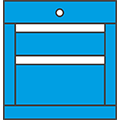
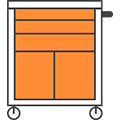








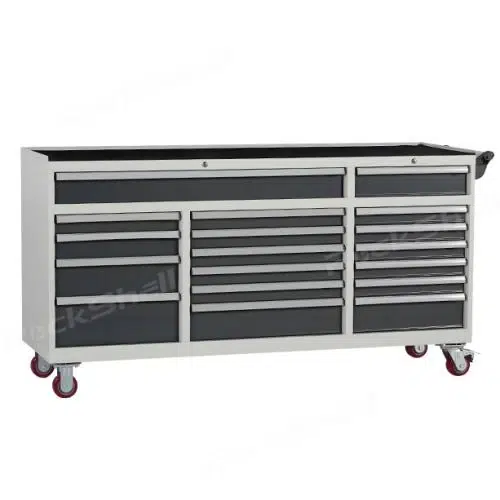




In modern industrial workshops, manufacturing plants, and professional maintenance environments, the industrial rolling tool cabinet has become an essential solution for improving workflow efficiency and tool management. Compared with stationary tool cabinets, industrial rolling tool cabinets offer greater mobility, convenient access, and adaptability across multiple work areas.
However, different specifications, structures, and configurations can lead to significant differences in performance and user experience. This guide outlines key selection criteria to help businesses make informed and practical decisions when purchasing an industrial rolling tool cabinet.
1. Focus on Load Capacity and Drawer Structure
When selecting an industrial rolling tool cabinet, the drawer slide configuration directly determines load capacity, operating smoothness, and overall usability. Different tools and equipment require different load ratings and extension options, which is why industrial-grade tool cabinets typically support multiple slide configurations.
Single Slide Drawer
Single slide drawers are designed for standard industrial storage needs, balancing strength and smooth operation:
Load capacity: Up to 100 kg per drawer
Extension: 85% smooth extension
Ideal for hand tools, pneumatic tools, and standard industrial components
Stable structure and cost-effective for most workshop applications
Double Slide Drawer
For heavy-duty tools or high-frequency access, double slide drawer designs provide higher load capacity and full accessibility:
Load capacity: Up to 150 kg per drawer
Extension: 100% full extension
Suitable for heavy power tools, molds, and large equipment
Maintains stable and smooth operation even under full load
Flexible Configuration for Diverse Needs
High-quality industrial rolling tool cabinets allow free combination of single and double slide drawers. Users can configure drawers based on tool weight and usage frequency:
Single slide drawers for light to medium tools
Double slide drawers for heavy or bulky tools
This flexible configuration improves space utilization and allows the cabinet to adapt to future tool storage requirements.

2. Caster Quality Determines Mobility and Safety
Casters are a critical component of any industrial rolling tool cabinet, directly affecting mobility and operational safety.
Key factors to consider include:
Caster material (polyurethane, rubber, etc.)
Load capacity per caster
Availability of braking mechanisms
High-quality industrial rolling tool cabinets typically feature heavy-duty industrial casters, with at least two locking casters to ensure stability during use.
3. Locking Systems and Safety Features
In industrial environments, both tool security and operator safety are essential.
Recommended safety features include:
Central locking systems for all drawers
Drawer interlock mechanisms to prevent multiple drawers from opening simultaneously
Anti-tip designs for enhanced stability
These features protect valuable tools while reducing the risk of workplace accidents.
4. Drawer Layout and Internal Accessories
A well-designed internal layout significantly improves tool organization efficiency.
When selecting an industrial rolling tool cabinet, consider:
Drawers with varied height combinations
Adjustable dividers and compartment boxes
Label frames or identification systems
Modular drawer designs allow businesses to adjust storage layouts as tool inventories evolve.
5. Material and Surface Treatment
Industrial environments demand high durability.
A premium industrial rolling tool cabinet typically features:
Cold-rolled steel or high-strength steel construction
Powder-coated or industrial-grade surface finishes
These treatments provide resistance to oil, moisture, and chemical exposure, extending service life.
6. Customization and Expansion Options
Standard products may not fully meet enterprise-level requirements.
Many manufacturers offer OEM / ODM industrial rolling tool cabinet services, including:
Custom dimensions and drawer configurations
Adjustable load ratings
Custom colors and branding
Customization support ensures long-term scalability and brand consistency.

Conclusion: Selecting the Right Industrial Rolling Tool Cabinet
Choosing the right industrial rolling tool cabinet requires a comprehensive evaluation of load capacity, mobility safety, internal structure, durability, and future expansion needs.
For high-intensity and high-frequency operations, prioritizing heavy-duty construction, premium casters, and comprehensive safety systems ensures long-term efficiency and reduced maintenance costs.


